Johari Window
Updated: Oct 23, 2024
Years ago, during an event discussing politics within High Education institutions, Alberto Arango, master and tutor (salud, maestro), brought an interesting point to the discussion: the very significant impact that our personal level of certainty has on the decisions we make and on their execution. From there, he guided us to discuss the reality of certainty, when not infrequently we don't know we don't know but we really believe (or want others to believe) we do.
To illustrate his point, he mentioned Johari Window, a matrix used by psychologists in group dynamics to compare and contrast what we know about ourselves and what the rest of the group know about us, as a mechanism to improve our self awareness and eventually our team work capabilities.
It is ingeniously simple: in a 2X2 grid, it considers the columns representing what is known to us and what is not known to ourselves. In the two lines, it considers what is known to others and what is not known to others. The intersection of columns and rows of four options:
Public area: What we know and others know about us.
Private area: What we know and others don't know about us.
Blind area: What others know but we don't know about ourselves, and
Unknown area: neither we or others know about ourselves:
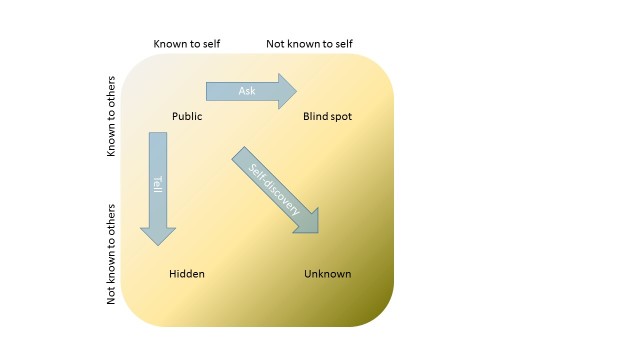
Designed as a test, participants select five or six adjectives from a list that they think that describe them well. Then, comparing the selections made by themselves and other participants, these four areas are identified for each person participating in the exercise. The window is used to define actions to improve self awareness, communication and assertiveness: To learn more about themselves, participants can ask others about what they know about them that the enquirer doesn't know about. They can also tell others about their private area, and can even explore what they don't know they don't know. Of course, it is a technique, and as such, limited, mechanical and artificial, specially when framed as part of those corporate events where frequently people doesn't want to attend, making the exercise even more forced and awkward. However, going back to the idea of better knowing what we know and we don't and moving the notion to our daily life can help to provide an useful tool to improve relations and ourselves. Curious? you can try the test online. Now, if you feel more adventurous and can take some criticism, you can try the Nohari Window, a sort of inverted version of the Johari Window using antonyms of the original adjectives. At least it is fun, and perhaps, just perhaps, even helpful.


Comments